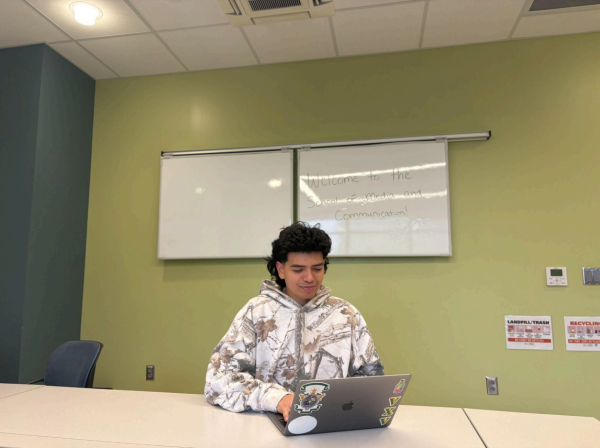
“I try to take them seriously because they are one of the only ways that students can directly contact teachers, and in my experience with them, I find that professors take them very seriously, changing [based on] recommendations that students have within those evaluations,” said BGSU student Alejandro Alvarez.
Bowling Green State University (BGSU) students may have noticed three new questions on their course evaluations last fall as a result of Senate Bill 1 (SB1), adding to the already long list of questions students answer about their instructor.
The three new questions were added to course evaluations in June 2025, per the Ohio Department of Higher Education.

BGSU’S School of Media and Communication (SMC) associate professor Rick Busselle said professors have varying opinions on the addition of the new question.
“Depending on who you are, it’s more or less frightening,” said Busselle in regard to BGSU professors who may be adjusting to this new policy. “I’m not that
concerned, but I can understand.”
These changes could also lead professors to reflect on their teaching methods, according to Busselle.
“I mean, I can understand why some people would be frightened. I also think maybe if you’re really frightened [of the SB1 changes], you think about how you’re handling class pressure,” said Busselle.
Busselle said newer faculty tend to take course evaluations more seriously, and due to the nature of faculty seniority, someone in his position can typically guess what students will say at the end of the semester.
“When you first start, people look very carefully at their evaluations and the new faculty worry about it a lot,” said Busselle. “By the time you get to my age, I pretty much know what you’re going to say.”
Busselle also said student feedback continues to help him modify his courses, even when the bulk of evaluation responses become predictable.
“I pretty much know what you want me to do, but I do go through them and say, ‘Okay, that’s something I didn’t think of,’” said Busselle.
Despite professors taking student feedback into account, many students do not fill the evaluations out, records show.
Only 45% of students in four randomly selected classes in BGSU’s School of Media and Communication filled out their course evaluations at the end of the spring 2025 semester.
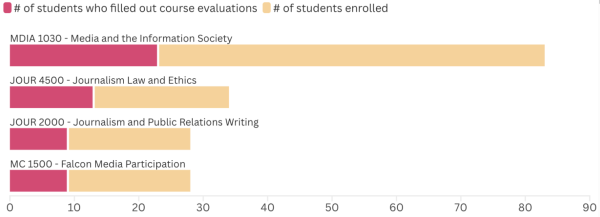
Many students aren’t aware of what happens to their comments after they’re submitted, and data shows the majority of students don’t fill them out. However,
students’ comments and scores, which now include reviews on intellectual diversity, do impact faculty’s ability to gain pay raises, promotion and tenure, university leaders said.
“We ask the students to take these course evaluations because they want to give feedback, but we deliberately didn’t make them required just in case a student
doesn’t feel comfortable,” said Jessica Turos, BGSU’s associate director of academic assessment.
BGSU students across all classes at the university are asked six common questions featured in all course evaluations beginning in the fall 2018 semester.
“When the course evaluations first came out, because it was a newer sort of piece, the response rate was pretty high. Now, we have a decent response rate overall, but it also depends on the course and the other sort of areas,” said Turos. “So, there are certain courses that have very high response rates, and other courses that don’t have as high response rates.”
In addition to the six standard questions, each school or department is able to add more questions as they see fit.
“There will be core questions that are the same across the university, and then there can be different questions added per department. But professors can’t edit those, at least I have never heard that you could,” said Busselle.
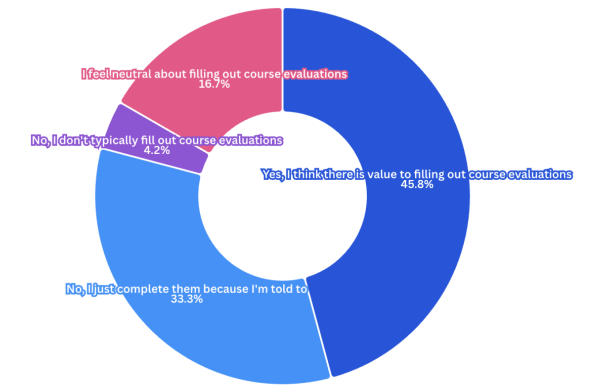
In a Falcon Media survey of 48 BGSU students across majors, 45.8% of respondents said they felt that there is value to filling out course evaluations.
In the same survey, 37.5% of BGSU students who responded said they either complete the course evaluations because they are told to, or don’t typically fill
them out when they are released.
Student evaluations have a direct impact on faculty’s merit scores, a number that decides whether or not they receive a raise each year. Faculty who receive
“decidedly negative qualitative feedback” fail to meet their merit goal for teaching, according to the School of Media and Communication’s merit document.
“If a faculty member was performing really poorly, and everyone has a bad semester, it’s not going to determine your fate,” said SMC director Cheryl Bracken. “But, if there’s a pattern and consistent poor performance, then there’s things like they’d get less money or no money for merit.”
Similarly to course evaluations, merit policies vary by school and department.
“Every unit does it a tiny bit different,” said Bracken. “They get to define what is unacceptable in their own disciplines.”
In addition to the merit policy, the faculty’s collective bargaining agreement, a contract effective from July 1, 2024 through June 30, 2027, states that an
extraordinary review process can be performed if tenured faculty receive an unacceptable rating–which can include course evaluations.
“They call this the ‘extraordinary review’ process, which would require the faculty member to submit what they call a ‘dossier,’” said Bracken. “This makes a case that they are still meeting the standards and that they are still performing to a satisfactory level.”
The extraordinary review process allows for the university to analyze if a professor is meeting its standards of teaching. However, the process is not, according to the collective bargaining agreement, “reevaluations or revalidations of tenure, nor shall they be used to shift the burden of proof from an institution’s administration to an individual tenured instructor.”
The process must be conducted according to standards that protect academic freedom, the quality of education and due process. It also demonstrates where the university uses, analyzes and takes into account student course evaluations when it comes to faulty employment and performance.
Some students said they believe that their input is being taken into account, even if they don’t see things changing in the classroom right away.
“I believe that professors directly read that feedback and change certain things within their course, but I also believe that there’s a lot of change happening behind the doors within the departments,” said BGSU student Alejandro Alvarez. “So, even if I don’t see change immediately, I know things are still changing over time.”
Alvarez also said he thinks course evaluations can help courses in the future, rather than just giving the professor something to reflect on.
“I fill course evaluations out because they are structured to be one of the only ways students can have a real voice in a class. If something helped me succeed, I would like the professor to know that,” said Alvarez. “If something didn’t really help me succeed, I would really like the professor to change that about their course. I think the input I’m giving is helping change the courses for future BGSU students.”
However, some students said they worry about the anonymity of course evaluations.
“I worry that if I am honest my professor will find out that it was me who wrote it,” a BGSU student anonymously wrote in the Falcon Media survey.
However, BGSU professors noted that once evaluations are submitted, the results and responses are provided to professors through Canvas with complete
anonymity.
“I absolutely understand you don’t want to associate the evaluation with the student. I mean, there is no way you would give an accurate evaluation if you knew
that [professors] knew what you wrote,” said Busselle.
Busselle noted that while student anonymity is incredibly important to the integrity of course evaluations, there may be some benefit to receiving data that matches course grades with a student’s anonymized course evaluation responses.
“The university, they’re adamant that you cannot associate the evaluations with the course grade,” said Busselle. “But in a big class, it would be easy enough to say ‘Here’s the relationship between the grades they earned and the evaluations they gave.’”
Busselle said it would be useful to understand how student performance aligns with evaluations.
“If the students who did better [in the class] gave better evaluations, and the students who didn’t do very well [in the class] gave lower evaluations, that would
be useful information,” said Busselle.
Busselle said he understands why BGSU may not want to implement this type of analysis into course evaluations.
“I don’t know if it’s too complicated for them to deal with the data, or if they’re really afraid of what they might learn,” said Busselle. “They kind of go hand in
hand [grades and course evaluation responses]. It would be pretty useful information.”
Despite minor critiques or recommended modifications suggested by BGSU students and faculty, course evaluations at BGSU continue to provide a space for
unfiltered and honest feedback from students.
“I think it’s a really powerful tool for students to be able to express their opinion about the classroom experience,” said Bracken.
For more information on what Senate Bill 1 is changing within the classroom, visit https://highered.ohio.gov/educators/academic-programs-policies/sb1/sb1.
For more information on merit policies across the university, visit https://www.bgsu.edu/provost/faculty-affairs/policies-guidelines/academic-unit-merit-document-2016-2019.html.
For more information on the collective bargaining agreement, visit https://www.bgsu.edu/content/dam/BGSU/provost/faculty-affairs/documents/unitmerit-docs/cba5-20240701.pdf.