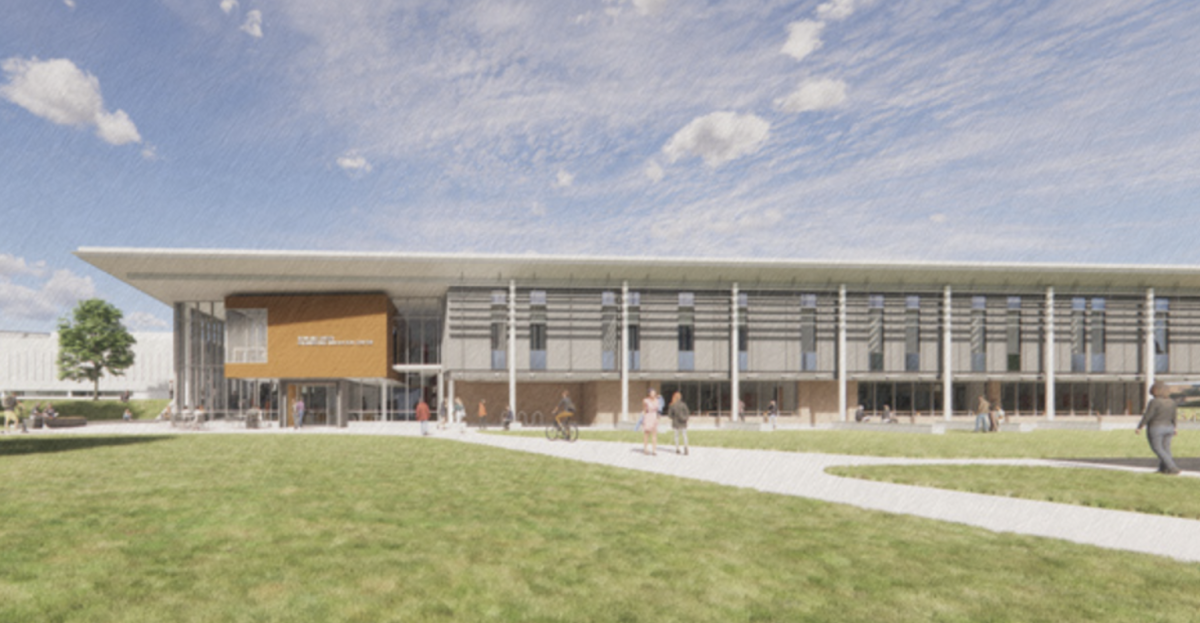
The spring 2026 semester marks the official opening of Bowling Green State University’s (BGSU) new Technology Engineering Innovation Center, which is now available for student and faculty use.
The new addition to the existing building has an estimated 24,000 square feet dedicated to in-person labs and collaboration spaces that are aimed at reflecting real engineering workplace environments.
“Our strength in BG is the level of hands-on,” said Wael Mokhtar, dean of the College of Engineering and Innovation. “With investing almost $39 million in the structure and equipment, our current and future students will have the ability and the chance to use tools that are totally industry matched. So, it cannot be a better preparation for day one as a professional engineer.”
Inside the estimated 24,000 square feet of new space are seven new labs, matching the number in the previous building, which include spaces for electrical, virtual reality, augmented reality, AI and 3D metal printing.
“So we have seven new labs. Originally, we had about seven or eight labs,” Mokhtar said. “Everything inside the building, the old side and the new side, is touching each other one way or the other. If there is an electrical lab, there will now be two of them.”
Construction of the new building began summer 2024 and held the official groundbreaking ceremony during 2024’s homecoming weekend.
The initial target was to have the new space open in 2026, and BGSU is currently adding finishing touches to the entire facility after the official opening.
“We did finish on schedule and on budget, which we’re pretty excited about,” said Kristin Peiffer, director of campus construction. “We did advance some additional scope during the midst of construction, so we are continuing that work in the existing building. But this addition opened as planned for students.”
Along with the labs and shops themselves, another addition is the collaboration space and accessibility for students throughout the building.
The labs feature glass windows, allowing other students and faculty members to see what is being worked on inside the rooms themselves. There are also lounge areas sprinkled throughout the building for students to meet and work on projects together.
“Now this building is the innovation model of where you have a chance to live as a community,” said Mokhtar. “You can see what everybody is doing, and students can create relationships and a sense of mutual learning. That’s more valuable than anything else, and I think the way this building is designed will have a huge impact on the students.”
When designing the new space, Peiffer said BGSU wanted to improve on the sense of connectivity to the building itself compared to the previous space.
“It definitely was a key component that we spent a lot of time on,” Peiffer said. “We really wanted to create a sense of community and heart. It (the previous building) just had a little bit of disconnectivity, so we really wanted to create this front entry space.”
The new building was also built with expansion and university growth in mind. The number of first-year engineering students has increased by about 35% over the last two years, so the spaces are designed to be flexible.
“One of the things we really spent a lot of time on is the labs themselves, which are built on a modular approach,” said Peiffer. “The idea that, as technology and equipment needs, ebbs and flows of the academic side, that each of the labs can adapt as well.”