

Higher education institutions in the United States are changing with the shifting world around them through state and federal legislature that impacts classroom discussion topics, the safety of international students and other foreigners, free speech rights and more.
Ohio’s Senate Bill 1 officially went into effect in June 2025, putting in place new requirements and limitations on public higher education institutions, like restricting relationships with China, changing the review process for faculty, removing DEI programs, limiting the discussion of “controversial topics” in certain classrooms and requiring intellectual diversity.
Some, like David Jackson, a political science professor and the president of the Bowling Green State University (BGSU) Faculty Association, say SB1 stems from a misunderstanding of what happens on college campuses.
“What you hear about what goes on on our campuses from opponents of higher education sounds like they’re talking about what’s going on on Mars or something,” Jackson said. “This place is not a hotbed of indoctrination. This place is a free market of ideas; it always has been and always will be. We didn’t need them to tell us that.”
However, Jerry Cirino, an Ohio State Senator and SB1’s primary sponsor, wrote that he believes the bill will enact positive reforms for higher education.
“Eliminating the abuses of DEI and re-establishing the right to free speech on campus are just part of my comprehensive legislation,” Cirino wrote. “This bill will enact true education reform and make our higher education system more attractive than ever, even as enrollments drop nationally.”
At the federal level, many people, including those at higher education institutions, say they felt the impact of recent actions like the suspension of entry and visa issuance of people from 19 countries and a more intensive crackdown on immigration laws.
As legislation comes out at the state and federal levels, some people are left wondering how they or their community will be affected. At BGSU, students, faculty and staff want to know what has changed at their university and what has remained the same.
“A true north for BGSU is making sure that each student has the opportunity to succeed, and that’s something that in the division that I work in [Division of Student Engagement and Success], and I know this is the case across campus, where that is our number one central focus,” said Glenn Davis, vice president of that division.
Many want to know if BGSU is still succeeding in the goal of this true north or if higher education institutions have become single-minded and hostile. A closer look at how BGSU has responded to legislation this year might provide a better understanding of how the BGSU community fared.
General university impact: Did anything really change?
BGSU saw changes in degree and student service programs due to SB1 requirements. BGSU’s World Language Education degree program was suspended for incoming students beginning in fall 2026 because it did not meet SB1’s minimum requirement of conferring five degrees within three years.
However, Katie Stygles, BGSU’s chief state and federal compliance officer and deputy chief community and well-being officer, said the university was already working on combining the smaller degree programs into broader ones to pool together resources and faculty. Although both methods have a similar goal of reducing the number of small and underused programs, SB1 cuts the programs completely.
Additionally, the Center for Women and Gender Equity (CWGE) and the Center for Student Connections and Opportunity were discontinued at BGSU under SB1’s removal of Diversity, Equity and Inclusion programs and trainings. The Division of Community and Well-Being was expanded to cover programming previously led by these centers.
Stygles explained some events and programs are compliant with the legislature, and still at BGSU, they are just being done by different people or offices. For example, the Green Dot and domestic violence awareness programs are still being offered by the Interpersonal Relations staff in the Office of the Dean of Students.
According to Stygles, everyone from the old Division of Inclusion and Belonging was redeployed to other jobs at the university with the intention of trying to place them in a job as similar to their old job as is allowable. For example, some former employees of CWGE are now in the Office of the Dean of Students, where they work with the allowable programs from their old center, like the Green Dot program.
“I think that you could easily say that long before SB1 came about, we were focused on coming at student support from as many different directions as possible. So while we understand that the loss of things like the Center for Women and Gender Equity and the Center for Student Connection and Opportunity is very meaningful and relevant and perhaps for some people truly sad, we also hope that our students aren’t feeling a huge difference in terms of support because we are focusing in on the supportive services that we can bolster and strengthen,” said Stygles.
SB1 also adds an American civic literacy course requirement for all incoming students and requires faculty to make their syllabi publicly accessible.
Louisa Ha, a professor in BGSU’s School of Media and Communication, said publicly posting syllabi brings up an issue of intellectual property for faculty.
“A syllabus to a faculty [member] is their intellectual property: like all the readings, all the topics and things like the references,” said Ha. “So when you post it online, then everybody can take it …”
Faculty also face changes in how they are evaluated in their post-tenure review, and some, like Jackson, said this new system is unfair towards faculty. Jackson said SB1 prohibits the faculty union from negotiating terms and conditions of faculty employment.
The faculty “are prohibited from bargaining over post-tenure review, which BGSU already has a version of that was working,” Jackson said, adding SB1 “gets rid of that version and gives a very specific new version.”
Jackson said this new version of post-tenure review prohibits the faculty union from negotiating over any form of faculty evaluation.
“We have currently many forms of faculty evaluation, but the law specifically creates a not-particularly fair version, a sort of ‘one size fits all’ version as compared to what we currently have,” said Jackson.
However, Jackson also noted the Faculty Association and Faculty Senate are working closely with university officials to create the fairest policy allowable and involve faculty input into its creation.
“I have faith and confidence in our administration not to impose draconian, unfair policies, but to actually listen to faculty input and develop proper policies in this case,” said Jackson.
Some faculty have also run into confusion about what they are and are not allowed to say in the classroom, given SB1’s restriction on the discussion of “controversial topics,” which includes issues like “climate policies, electoral politics, foreign policy, diversity, equity and inclusion programs, immigration policy, marriage or abortion.”
Jackson said he sympathizes with and understands faculty who are concerned about the chilling effect, the concept of not exercising a right like free speech due to fear of repercussions or consequences. He added some faculty have chosen to alter what was being covered in class out of fear of backlash or getting in trouble.
“So my advice to our colleagues has been to comply with the statute when they feel confident, maybe because of tenure status or longevity of service, to cover things the way that they want to cover them and have done so in the past and continue to do so,” said Jackson.
Jackson said if a faculty member feels threatened, the faculty association would protect them.
“Each person has to make their own decision about how they want to proceed in their classrooms based on who they are and what their level of confidence and power is,” said Jackson. “But at the end of the day, the backstop that every faculty member has is that the faculty association would be with them every step of the way if there should be a complaint made against them for how they cover something in the classroom.”
However, Stygles said there is a misunderstanding of what the restriction of “controversial topics” in the classroom really means for faculty and students. She said the law actually aims to give students the understanding that the conversations, discussions and debates that take place in the classroom will be within the area of academic expertise for that field.
“So, if somebody is going to a class on introductory statistics, arguing the merits of the availability of abortion or unavailability of abortion to the population, [it] probably isn’t going to be academically relevant,” she said. “But if a student is going to a course on family structures and economics or societal problems or a women’s, gender and sexuality course that is looking at intersections of women’s rights and healthcare or something like that, then a student could expect that that would be an academically relevant topic to be able to have some discourse about.”
Stygles said with this law, the legislators want students to make up their own minds by gathering a variety of information.
“So [it’s] teaching students how to come to conclusions, not what conclusions to come to,” said Stygles.
Similarly, Ohio State Representative Josh Williams supports SB1 and wrote that the bill allows students to freely ask questions and express their own ideas.
“This bill safeguards free speech rights, preventing professors from penalizing students for holding opposing views,” wrote Williams.
Stygles encourages any faculty who are struggling with how to remain in compliance with the legislature while discussing a relevant “controversial topic” in class to ask for clarification and help.
Although there have been changes, some things have stayed the same at BGSU that other universities have had to adjust to be compliant. SB1 requires all positions, policies, programs and activities to be open to all students, which was already a requirement for student organizations at BGSU.
There are student organizations like the Queer Trans Student Union, the Queer Literature Club, the Black Student Union and the Chinese Language and Culture Club that focus on one identity, but any student has been able to join and participate in them.
“At the end of the day, these groups are really meant to help our students explore all kinds of identities,” said Davis.
BGSU also continues to celebrate nationally recognized heritage months like Hispanic or Native American Heritage Month and Black History Month. Davis said these celebrations aim to provide various opportunities to showcase history and heritage by allowing people to explore something new or to honor their own traditions and cultures.
“So we’re still going to be able to showcase what makes us different in ways that still bring folks together,” said Davis.
Similarly, Stygles said acting like a community is vital to life at BGSU.
“It’s important that we focus on how we as a community can continue to show up for and with one another in the way that is kind of that BGSU way as a public institution for the public good,” said Stygles.
Jackson calls for students to continue being who they are, even in the wake of possibly confusing times crowded with legislation from all sides.
“I just encourage students to continue being who students always have been, which is enthusiastic, critical thinkers, skeptical, challenging of everything they hear but in a sociable and polite way, to ask questions, to never assume anything, to be ‘difficult,’” said Jackson.
Foreigner impact: When home turns hostile…
“When you have a negative environment, then it [will] hurt the Ohio economy: not just people who don’t want to come to study, but other people don’t want to stay to work… so people leave,” said Ha.
Recent legislation effects foreigners in the U.S. and at BGSU, from SB1 to a federal executive order that restricts people from certain countries coming to the U.S., to HR1, the One Big Beautiful Bill Act, that provides additional funding to the U.S. Immigration and Customs Enforcement (ICE).
Additionally, Ohio’s House Bill 1 and Senate Bill 88 aim to restrict property ownership in Ohio by foreign nationals from “adversarial countries” by prohibiting them from owning property within a 25-mile radius of “critical infrastructure” and armed forces jurisdiction and from owning agricultural land. Currently, these countries include China, Cuba, Iran, North Korea, Russia and Venezuela.
The Ohio Farm Bureau wrote in their proponent testimony that SB88 will protect Ohio farmland.
“Land owned by foreign adversaries is only the latest threat to protecting farmland not just in Ohio but across the country,” wrote the Ohio Farm Bureau.
Ha said these bills, which have not yet been passed, wrongfully judge people based on where they are from, not on what they have done as an individual.
“I think that it is very dangerous when you look at only at the country of origin rather than what people did to society,” she said. “For example, if they really do criminal activity and they are a danger to society, of course, nobody would oppose this bill… but this is just labeled by the country of origin.”
Ha explained BGSU has been inclusive in welcoming international students and faculty, so these bills could impact many people in the community. She also said the list of “adversarial countries” can change at any time, so it could deter any foreigners from coming to BGSU or Ohio out of fear their origin country might be added to the list.
Ha noted most people from those countries have no control over what their government does and come to the U.S. just to study, work or for a better life.
“You sacrifice a lot when you come, but then when you come here, you get all this hostility and stereotypes you don’t deserve, which is very bad,” Ha said. “Especially in the U.S., we talk about civil society and we talk about human rights, but we don’t give human rights to other people from other countries of origin.”
Ha said some legislators generalize all immigrants as criminals because a few of them are, but don’t treat natural-born U.S. citizens with the same generalization, even though some of them are criminals.
“Legal immigrants, they pass through all the hurdles and requirements to become an immigrant. They pay taxes and they do the same contribution to society as the other U.S. citizens,” she said. “They should get the same rights.”
SB1 restricts Ohio’s public higher education institutions’ relationships with China by prohibiting the acceptance of gifts and donations, requiring the institution to notify any new or renewed academic partnerships and requiring structural safeguards to protect intellectual property in the case of an academic partnership. The law does not prohibit Chinese citizen students from attending and paying for Ohio’s public higher education institutions.
“On one hand, you welcome Chinese students from mainland China to study here and pay tuition; on the other hand, you don’t want us to communicate with them [China],” said Ha.
Ha explained with this law and with China being listed as a foreign adversary, many people are incorrectly associating all people of Chinese descent with the Chinese Communist Party (CCP).
“They are different things. Not everyone in China is CCP,” said Ha.
Ha also noted the long history the U.S. has as being “an immigrant country,” which some of the recent legislation seems to go against.
“I think that the immigrant tradition of the U.S. makes the U.S. great because we attract talent from around the world. Anybody who embraces American values and wants to pursue the American dream… they can apply legally,” said Ha.
Similarly, Jackson noted the U.S. has traditionally been a destination country for international students to attend university. He explained it as a win-win for the U.S.
“The fact that we have traditionally been a destination country for international students has mostly been previously perceived as a net benefit for the country because we either educate people who stay here and do good while they’re here, or we educate people who go back home and say good things about the U.S. when they’re away. I just don’t get it—why are we trying to mess up a good thing?” asked Jackson.
Student 1, a BGSU international student who asked to remain anonymous, similarly said they used to get messages and questions from prospective international students who wanted to study in the U.S., whereas now they don’t remember the last time they received a message, likely due to the uneasiness towards foreigners in the country right now.
“I don’t think the U.S. as a destination is as attractive as it used to be, not even years back, just a couple of months back,” said Student 1.
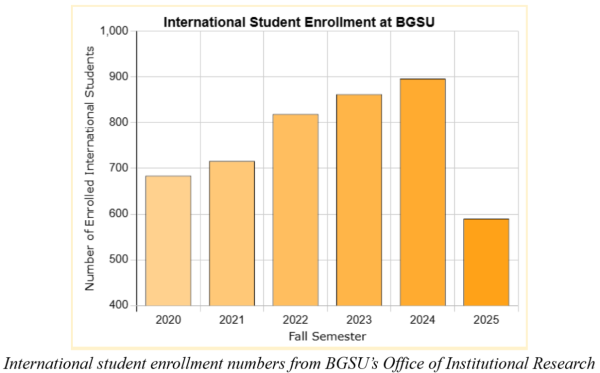
In fall 2025, BGSU welcomed its largest freshman class ever and had a total of 20,383 students, the largest enrollment in more than a decade. However, according to BGSU’s Office of Institutional Research, there was a severe decrease in the number of international students, with only 590 enrolled in fall 2025, compared to 896 international students who enrolled in fall 2024.
Ha explained even though legislation like SB1, executive orders, HB1 or SB88 do not directly prohibit all international students from coming to the U.S. or attending an Ohio university, they create a more hostile environment that will push many of them away. Jackson agreed.
“With the attacks on higher education that are happening and other things that are going on in the country, the U.S. is risking losing its dominant role in being a destination for students because we have the best higher education system in the world… Do we want to give up that place of dominance to other countries, I don’t think so,” said Jackson.
Student impact: An international student’s story…
International students especially felt the impact of recent federal legislation. According to Reuters, about 80,000 non-immigrant visas have been revoked since Jan. 20.
Reuters also reported more than 6,000 student visas were revoked as of August, mainly due to overstaying visas, breaking laws including assault and driving under the influence, and a smaller number due to “support for terrorism.” Among those international students who had their visa revoked was BGSU’s Student 1.
Student 1 said there were lots of rumors about students getting their visas or I-20s, a legal form that shows the student was legally enrolled in a U.S. study program, revoked without any cause. However, they said they didn’t believe it at first because it didn’t seem “real.”
“I knew in America the laws work, so these things aren’t supposed to be happening in the first place,” said Student 1.
Student 1 has been at BGSU for a few years and has both domestic and international friends. They said BGSU feels like their home and would like to stick around after they finish school.
“For now, the immediate goal is [to] be able to stay around and give back to the society that gave to me, and then when it’s time, also go back and give back to my country,” said Student 1.
This sense of community and belonging made the shock of getting their visa and I-20 revoked even more intense.
“Initially, it was difficult to understand, try to process it, and know the initial thought that, ‘Is my time here over? Is my dream over?’ and all those things were quite difficult to process in the first place. But then I knew we are in a very democratic country, so these things can be challenged in a court of law,” said Student 1.
BGSU faculty members used crowdfunding to cover the cost of legal fees. Student 1 noted some students from other universities had to fund it on their own.
“I know it was difficult for those kinds of students. I was just lucky to be in a place where my faculty were willing to help,” said Student 1.
With the help of faculty members, Student 1 was on the brink of filing a lawsuit for revoking their visa and I-20 without just cause, until they were notified their I-20 was restored. The I-20 validates their stay in the U.S., but their visa was not restored, so they are not able to exit the country to, for example, visit family, and come back in unless they go through the entire application process again.
Student 1 cited the pressure from the media coverage and the loss of other international students’ lawsuits as a main reason for this restoration.
“The pressure was much more than I’ve ever seen. I was really grateful for that support from various angles from attorneys, from law enforcement agencies to senators and representatives speaking on our behalf, knowing that this is not the right thing to do,” said Student 1.
Student 1 mentioned there are legal reasons for visas to be revoked, such as working without authorization or not going to classes, but they hadn’t done any of that. They said the only thing that might have set them apart was one run-in with the law that was dismissed and didn’t even make it onto their record.
Student 1 said there were other international students who were getting their visas revoked for things as small as warnings and parking tickets.
“In my understanding, it was just a mass reach into a database that had any immigrant or people who are not citizens of the U.S. who had any interaction with law enforcement,” said Student 1. “So if you’ve been stopped by the police to be given a warning and it was recorded by the policeman, your name is in that system, and so they just went into it and then just mass revoked the visas of all those people.”
In June, the U.S. State Department announced it would monitor the social media accounts of non-immigrant visa holders to determine if they are a national security threat. According to Axios, U.S. Secretary of State Marco Rubio is launching “Catch and Revoke,” which uses AI to review non-U.S. citizens’ social media accounts for any support of terrorist groups like Hamas.
This “one-strike policy” has deterred some international students from using social media at all.
“I know a lot of international students who have decided not to be active on social media anymore and just keep to themselves. And it’s also an effect on your social life because you don’t want to be involved, you don’t want to be caught at the wrong place at the wrong time,” said Student 1.
Student 1 said many international students no longer want to be in crowds or certain public spaces out of fear that something might happen, and they will be caught in the theoretical crossfire.
“A big aspect of coming here as international students is the willingness to assimilate in the culture. These things limit that kind of ability to do so,” said Student 1.
Student 1 said they monitor the news constantly to know what’s going on around them and what places are best to avoid. For example, if they want to take a walk in a park but know there will be a protest there, they will avoid the park just in case anything happens.
“In the end, you have to just stay to yourself, stay home, go to class, and just come back home and that’s it,” said Student 1.
Student 1 explained they felt safe in the U.S. before and enjoyed traveling to different states and Canada, but now free movement of international students is limited and fear has settled in.
“I don’t think any international students feel safe right now, no matter where you are,” said Student 1.
Student 1 said where they once smiled and waved at law enforcement officers, they are now cautious and wary of them.
“I’m not living as freely as I want to or as I used to a couple of years back before these things started happening,” said Student 1. “You don’t know what is coming up next, you don’t know what the next executive order [is] that is going to wipe away everything.”
Not only has this change affected the individual student, but also the general community of international students. Student 1 noted that they rarely see other international students randomly on campus anymore.
“It’s not as vibrant for us as it used to be. I used to attend a lot of on-campus events and see a lot of international students around… I don’t see them anymore,” said Student 1.
Student 1 went on to say that some of the aspects of college student life enjoyed by domestic students are no longer available to international students.
“You never know which wrongdoing is going to end your stay here in the U.S. So everyone is just trying to be smart and just lay low. The other aspects of life that made it fun for us to be in the U.S., I think, has been taken away from us,” said Student 1.
Student 1 said people should keep in mind basic human decency and remember they don’t always know what someone’s situation might be and where they are coming from.
“You never know what people went through before they got to where they are now, only for everything to be washed away by one executive order,” said Student 1.
However, even during a time of uncertainty where their life looks a lot different than what it was a few months ago, Student 1 doesn’t want or plan to leave BGSU.
“I feel really, really good in my program, I feel good around the faculty I’m with, I feel good with my advisor. I just don’t want to throw that away and have to start out fresh from a different place,” said Student 1.
Student 1 also noted the BG community and the family they have built here as another reason why they plan to stay.
“I’ve not really seen any changes in the relationship between domestic students and international students,” said Student 1. “I think it’s not a reflection of the larger American population.”
Free speech impact: The American idea of the past, present or future?
Some question if recent legislation allows them to exercise First Amendment rights or if they are an illusion of the past.
The First Amendment of the U.S. Constitution establishes the right of free speech, press, religion, assembly and the right to petition the government. With federal legislation monitoring foreigners’ social media activity and SB1 restricting the discussion of “controversial topics,” some people wonder if they still have the right to free speech in the U.S.
Student 1 noted although they are not active politically on social media, they noticed the legislation that monitors foreigners’ social media activity has chilled the voices of some international students who are politically active. Student 1 said they don’t think this is fair because it limits their right to free speech and assembly.
“I have no say in whatever is going on, what is right or wrong. I cannot advocate for things I believe in because anyone can interpret it in a different way, and I’m going to be in trouble,” said Student 1.
Davis, the university vice president of the Division of Student Engagement and Success, said one of his biggest concerns with incorporating SB1 into BGSU was students fading into silence instead of asking what was still allowed while maintaining state and federal compliance. He said he encourages students to confirm certain things can’t be done rather than assuming.
“It’s not to say that we’re going to be able to do everything the way that we could previously, but [it’s] much better to have an open conversation, understand where those boundaries exist and then work together to make sure we are still able to do as much as possible for our students,” said Davis.
Davis said there has been an open communication line between the Division of Student Engagement and Success and students, faculty and staff to ensure the university complies with the law in ways that uphold its intent without introducing unnecessary restrictions or burdens.
Ha noted when a university becomes over-compliant, they have lost their sovereignty as a university. She said BGSU has done a good job at reacting to things that need to be done to be compliant without over-complying.
“We are not the political machine of the government, so I think it is very important to maintain that kind of autonomy,” said Ha.
Similarly, Jackson noted the possible unintended repercussions of the imposition of the government in higher education.
“The people who voted for Senate Bill 1 say it should change nothing about how we cover controversial subjects in the classroom. However, when the state gets involved and micromanages what goes on in classrooms, what they intend versus what happens can be different things,” said Jackson.
Stygles said there have been many discussions between BGSU’s President Rodney Rogers and other university staff with legislators to understand exactly what the law requires of the university.
“And then it is making sure that we communicate well what compliance is and isn’t and that we have systems in place to be able to support people in being compliant,” said Stygles.
Davis said BGSU is working to ensure that all students know that they matter on campus and have the support they need.
“We represent a broad range of opinions on our campus, and that’s what a healthy university campus has: people who have all kinds of different opinions,” said Davis. “And then how can we as a community—because we are at the end still one learning community—how do we make sure that we are able to respect each other, to learn from each other; it doesn’t mean that we’re going to walk away agreeing necessarily, and that’s also okay in a democratic society.”
BG Falcon Media reached out to a total of 14 potential interviewees (10 faculty and staff members and four students) for this story and five agreed. The few that disclosed why they did not want to participate in this article cited fear of consequences or backlash on them or their organization as the reason.
For more information on how BGSU has adopted SB1 into the university, visit their FAQ page.







Cheryl Meisel • Dec 7, 2025 at 1:30 pm
I agree with this and I think the speaker said it all. This is a very dangerous time and our very lives are being threatened as Americans. We have to fight with words like this and actions to protect our freedoms.
God be with us all.