All of the information in this article was provided by Judge Matt Reger from the Wood County Court of Common Pleas.
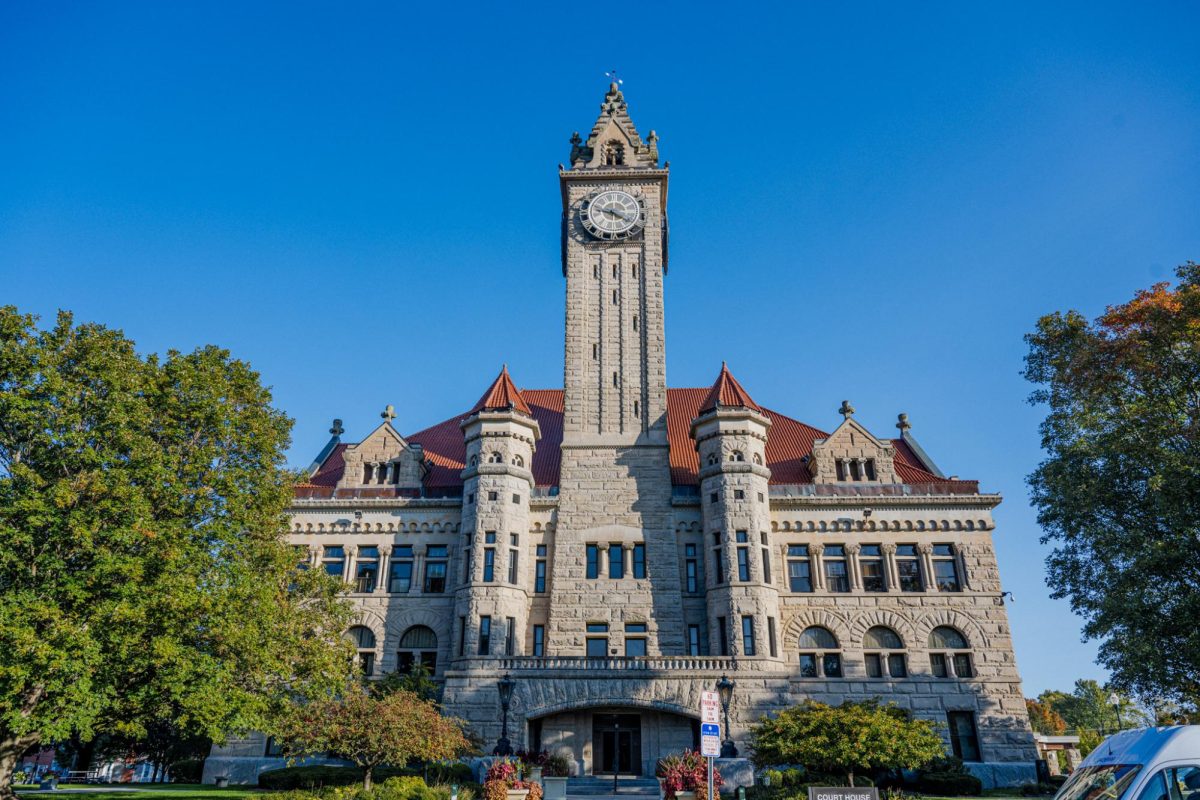
The Wood County Courthouse, affixed with the Wood County clocktower, rises above the Bowling Green skyline. This seat of justice dates back to its cornerstone laid on July 4th, 1894. History is baked into its walls.
Wood County, founded in 1820, originated as the foremost producer of crude oil in the country. A large population sprang up around the booming business of over 30,000 oil wells.
Wood County was named after Eleazar Darby Wood, a West Point graduate and engineer who constructed Fort Meigs in Perrysburg. Fort Meigs was a pivotal fortification of the War of 1812, as the British and Tecumseh failed to capture the stronghold during the siege.
Both the oil boom and Fort Meigs are commemorated in expansive murals on the courthouse’s third floor.
The entrance sculpture reflects sentiments of the time: with Lady Justice placing her hand gently on agriculture while waving a warning finger at commerce and the laws of Ohio.
The courthouse originally was situated in Perrysburg along the river, while the rest of the county remained swampland. After the Civil War, it became a controversial decision to move the courthouse southward, to Bowling Green. The election for the courthouse was riddled with accusations of fraud and ballot stuffing, but clever businessmen had already acquired the land and money. Immediately, the courthouse construction began.
Designed in the Richardsonian-Romanesque style, the courthouse combines Roman pillars and round windows with medieval stone cuts and grotesque faces to ward off evil spirits. Cast iron rails promote the newest technology of that era, the light of eternal justice is emblazoned on the floor tiles and each doorknob is marked with a “WC” for Wood County.
Repairs and restorations follow this unique style. The 2004 addition of the atrium used the very same masonry to properly integrate the original stone.
Yet, the County Commissioners who designed the courthouse in 1893 were indicted.
The commissioners were allotted $200,000 under the Ohio legislature; surplus costs had to be presented to the voters of Wood County for their approval. Still, contracts were signed without a popular vote. Anywhere from $50,000 to $80,000 of additional expense was accrued. Three commissioners were convicted, and two were removed from office in the same courthouse they constructed.
While the Wood County Courthouse is open to the public, legal proceedings were featured more prominently as entertainment in the past. Until the 1920s, a balcony overlooked the courtroom, for laypeople to observe the rulings. In this courtroom, one mural features an American flag that, to this day, only has 48 stars.
Cases from the courthouse’s history are highlighted within its walls.
For instance, in 1881, the last execution occurred in Wood County.
Carl Bach and Mary Bach lived on a farm with their three children just south of Bowling Green. When Mary protested Carl’s proposition to sell the property and move west, he began to violently threaten his wife. The equivalent of a protection order was placed, and throughout the summer of 1881, Carl lived in the barn.
However, one day, he broke back into the house and, upon her arrival, murdered Mary. Carl turned himself in and was convicted and sentenced to death.
Counties were allowed to perform private executions, meaning paid tickets were required to view. The 1881 County Fair sold tickets, and on the last day of the fair, Carl Bach was executed. Right after, the law changed; counties could no longer perform executions.
From this final death sentence, the rope, shroud, knife and newspaper article were preserved. Additionally, Mary Bach’s fingers, which were collected at the murder scene, were displayed in the Wood County Courthouse for 80 years, but have since been relocated to the Wood County Historical Society.
In 1896, Jesse Baker was the first officer killed in the line of duty in Wood County, serving as the constable in North Baltimore.
In attempts to prevent a robbery of the North Baltimore post office, Baker and his dog, Jack, were shot and killed by the thieves. The first jury trial of Wood County convicted Thomas Jones of Baker’s murder. A photograph of this 1896 jury is still hung in the jury deliberation room today.
The hallways are also lined with historical facts and photographs. The Wood County Courthouse hosted William Howard Taft in 1912 and Ronald Reagan in 1988. Before shipment during World War I, soldiers were photographed in front of the armoury.
Furthermore, the courthouse originally had a jail, with the front serving as the sheriff’s residence and his wife serving as the matron of the jail. This location now hosts the Office of Records for the county. Any interested parties can use family marriage records, dating back to the 1820s, to trace their lineage.
The courthouse is fully functioning to this day, with three common pleas judges who rule on civil, criminal and felony matters. Probate court encompasses juvenile, marriage, custody, licenses and estates, while municipal court focuses on misdemeanors and small claims.
As the Wood County Courthouse continues renovations today, this seat of justice will continue for decades to come. History is in the making at Wood County.
Explore more about Wood County’s 200 years of history through the primary documents of the Wood County Bicentennial Project: https://ohiomemory.org/digital/collection/p16007coll96/search