
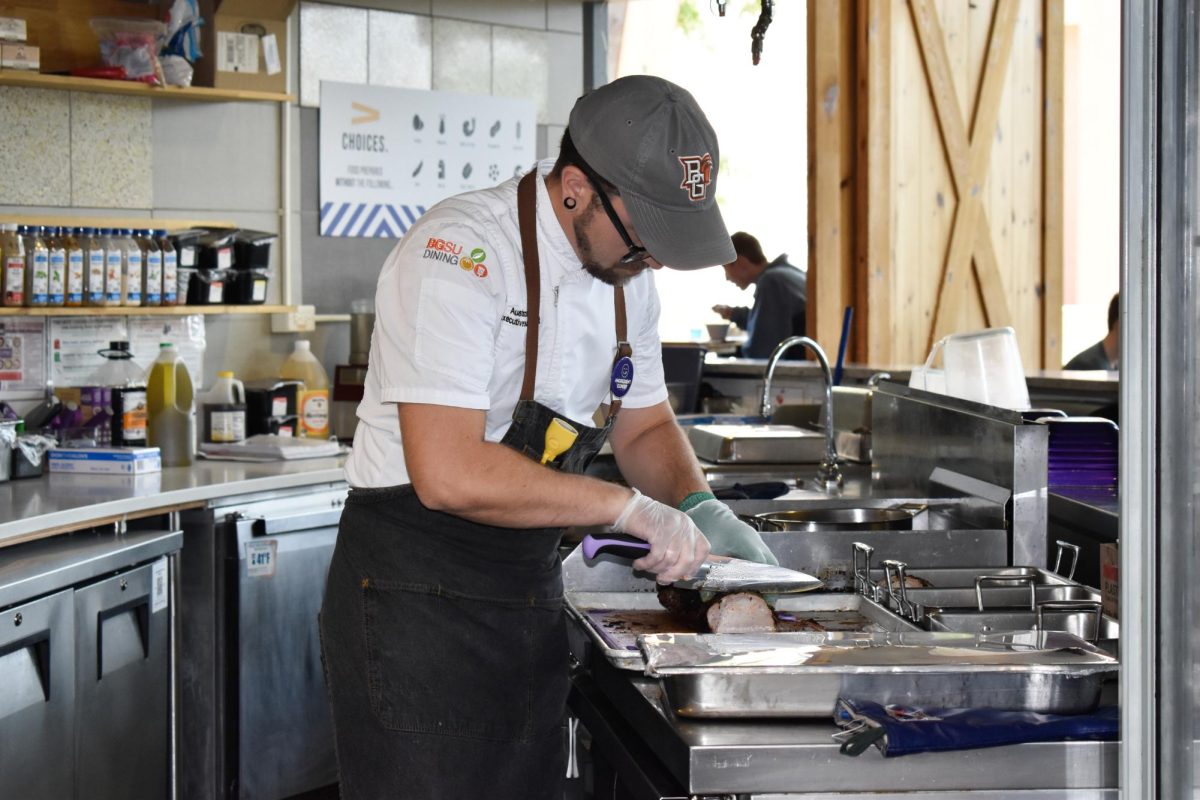
One of the primary ways humans consume microplastics is through the foods they eat. That means not only does what you eat matter, but how it was prepared matters too.
For Bowling Green State University (BGSU) students, the primary concern is how they are exposed through on-campus dining.
“Our team works to keep plastic use as low as possible by choosing reusable and compostable options whenever we can,” said Jon Zachrich, director of Marketing, Communications, and Technology for BGSU Dining, in a message.
However, Calista Wilkins, a former BGSU Dining employee, has another story to tell.
“Cutting boards are all plastic and super old. You can see the cut marks in them, and plastic is 100% leaching into the things cut on it. They should have been replaced years ago,” Wilkins said in a message. “Most of the time, plastic wrap is used to cover things instead of a reusable plastic lid, ‘because it’s convenient’ even though we had reusable lids.”
While there are some ways the kitchens avoid plastic, such as using stainless steel pans and using mostly metal utensils and mixing bowls, they do not accomplish it in every way, according to Wilkins.
“We are supposed to be environmentally conscious. We even had a tablet on the wall right next to my workstation you log waste on, and I saw it used once the whole time I worked there,” Wilkins said.
Microplastic exposure even extends beyond the kitchens and into the food court.
“They don’t have metal silverware in the student union food court. It’s all single-use plastic. Their excuse was they didn’t want to have to deal with washing the forks, knives and spoons,” Wilkins said.
Wilkins isn’t the only former BGSU Dining employee to notice these issues.
“Sustainability didn’t seem like a big focus in the workplace,” said former Cantina 1910 employee Ciana Nero. “We used metal items instead of plastic whenever possible, which is definitely more sustainable since it cuts down on single-use waste. Other than that, there weren’t really any major sustainability practices that stood out to me.”
While employees notice issues, statements from BGSU Dining remain positive.
“Our team works to keep plastic use as low as possible by choosing reusable and compostable options whenever we can. In our larger dining halls, we use real plates and metal silverware to cut down on single-use items,” Zachrich said.
Solutions to this microplastic exposure in dining are possible.
At Northern Arizona University, students have reusable containers made of stainless steel, according to Clean Technica.
In addition to containers, there are also compostable/biodegradable single-use utensil options made of agave, making them convenient for to-go dining, while also keeping human bodies and the environment plastic-free.
For more information about microplastics and dining, read the Environmental Protection Agency’s Marine Debris and Plastic Source Reduction Toolkit for Colleges and Universities.