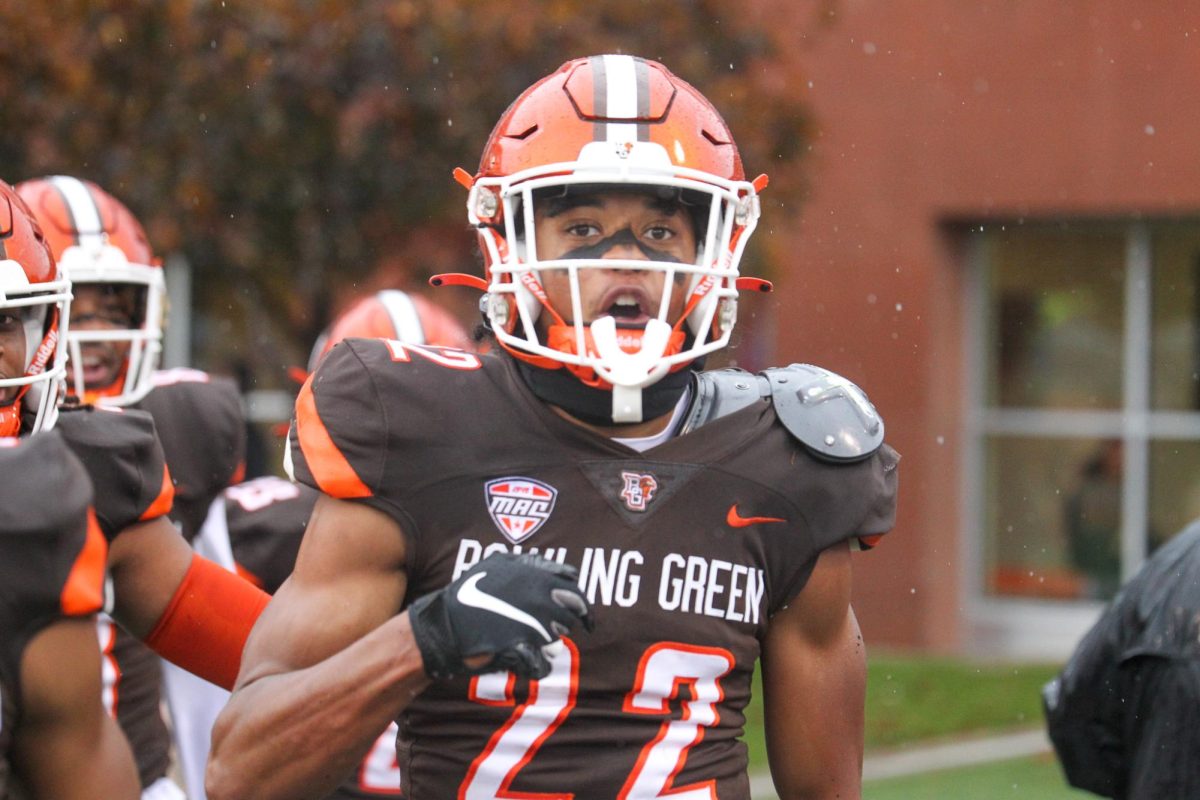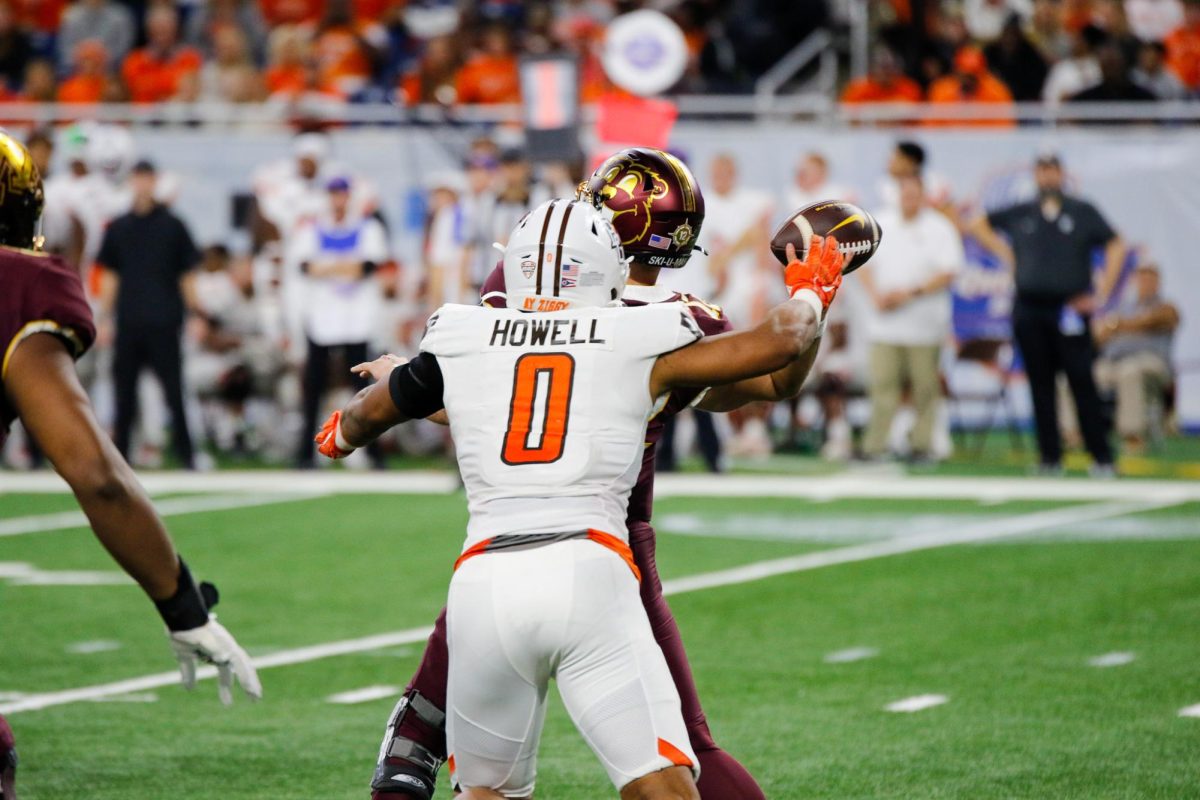

Nearly four decades later, those who wore orange and brown during the 1985 season still remember not only the plays that defined the year but the brotherhood that made them possible.
The 1985 Bowling Green State University football team is remembered not just for its record but for the unforgettable moments it created. At its core, the Falcons’ defense was built on toughness, trust and an unshakable bond that turned individuals into a united force.
Building the Foundation
Defensive coordinator and linebackers coach Tim McConnell, secondary coach Jon Hoke and defensive line coaches Ed Schmidt and Mark Smith molded a disciplined, accountable unit.
“We tried to keep it as simple as possible so they weren’t confused and didn’t overthink,” McConnell said. “We wanted them to react and do what they saw on the field. I pushed these kids, and they were tough, hardworking, and very talented, determined to play for us. I’ve been coaching 12 years, and these guys were special. I give all the credit to the players.”
McConnell’s system reflected that mindset. He implemented a 4-4 stack (basic explainer here) and a Cover 2 with rolling corners (basic explainer here) — an uncommon combination at the time — which propelled BGSU’s defense to 28th in the nation in points allowed. Flexibility was key: Defensive backs often shifted into linebacker roles, and conditioning and fundamentals were never compromised.
The Falcons’ leaders included cornerback Melvin Marshall, who had four interceptions (the team totaled 18) and linebacker Troy Dawson, who recorded 153 total tackles. Bowling Green ranked sixth in the MAC against the run (144.0 yards per game) and fourth against the pass (175.3 yards per game).
More importantly, the defense gave up just 15.6 points per game, second-best in the conference behind Central Michigan. Marshall earned first-team All-MAC honors, while Chris Hartman, Vince Villanucci, Mike Foor, Troy Dawson and Dean Bryson were all named to the second team.
Making a Statement Early
The season opener at Ball State gave fans their first glimpse of how dominant the defense could be. The Cardinals, coming off a 3-8 campaign in 1984, averaged 18.5 points per game but struggled mightily against Bowling Green’s swarming unit.
In Muncie, Indiana, the Falcons set the tone early. Erick Johnson recovered a fumble that set up a 39-yard field goal. Then Marshall — a respected locker room leader — intercepted a pass and returned it 62 yards for a touchdown.
By halftime, the Falcons led 19-6. In the third quarter, Marshall struck again, returning a deflected pass 21 yards for his second touchdown. His two pick-sixes tied an NCAA record for most interceptions returned for touchdowns in a single game.
Bowling Green’s defense smothered Ball State, holding the Cardinals to just 189 yards of total offense.
Defensive back Rick Howard recalled Marshall leading by his actions.
“He was a no-nonsense guy who made few mistakes. He was very precise in his footwork, which put him in great position with a strong knowledge of the defense. He led by example, and all of us bought in, watched him, and didn’t want to let the brother beside us down,” Howard said. “Melvin was like the dad of our defense, making sure everyone was accounted for.”
The Miami Miracle
Their most unforgettable moment was still to come. Later that season, the Falcons rallied from a 10-point deficit in the final two minutes to stun Miami in what became known as the “Miracle of Doyt Perry Field.”
The details — from Rick Neiman’s clutch throws to Howard’s recovery of the onside kick and Schweitzer’s crucial block that made it possible — remain vivid in the players’ minds nearly 40 years later.
Paul Schweitzer remembered the moment clearly.
“On the crucial block, I was running down and there was a blocker in front of me. I knew I needed to get to the guy who received the ball. I had no choice — I ran into the blocker, took him out, and had my eyes on the runner. After I made the play, I tried to get off the ground but saw Rick Howard recovering it, and I went crazy. It all happened so fast, like a blur.”
That recovery set up Neiman’s game-winning drive.
“I remember it like yesterday,” Howard said. “I was in the huddle for the kickoff, and I told everyone, ‘I’m going to get the onside kick.’ I just had this eerie feeling. When the ball came over, everything was moving in slow motion. Once I made that play, we knew we were going to win.”
But even after that recovery and Neiman’s subsequent touchdown to garner the lead, the game wasn’t over. It took Schweitzer deflecting a pass in the end zone on the game’s last play to seal the victory.
This was critical at the time because whoever won this game was likely to win the conference. With the Falcons’ defense giving up a total of 382 yards and one fumble recovery, the Falcons took the victory 28-24 with the help of key defensive plays.
Staying Unbeaten
After that win, Bowling Green rolled to a 4-0 record with victories over Ball State, Kentucky, Miami and Akron, two in conference and two out of conference. Next came a showdown with Western Michigan, led by Jack Harbaugh, a BGSU alum and former coach.
The Falcons dominated, winning 48-7, forcing six turnovers (three interceptions, three fumbles) and turning them into five offensive touchdowns.
The trend continued against Eastern Michigan, with another 40-plus-point outing, but the real test came on the road against Central Michigan. The Chippewas, one of the strongest teams of the 1980s, had beaten BGSU in three of the last four matchups.
This time, the Falcons were ready. Despite giving up nearly 500 yards of offense, Bowling Green’s defense delivered in the clutch.
With the Falcons clinging to a 10-9 lead late in the game, Marshall came up big again, intercepting a pass in the corner of the end zone. On the very next drive, Sean Dykes picked off another pass over the middle, setting up Brian McClure’s touchdown strike to Stan Hunter.
The Falcons held on for a 23-18 victory, improving to 7-0 and continuing their march through the MAC.
Next came Kent State, which finished the season with an overall record of 3-8 and a MAC record of 2-6, and Northern Illinois, which concluded with an overall record of 4-7 and a MAC record of 4-4.
Against Kent State, Bowling Green’s defense rose to the occasion. The Golden Flashes were unable to capitalize on five drives that started inside Bowling Green’s territory early in the game, largely due to offensive struggles. However, Kent State managed to take a 7-0 lead in the first quarter.
Shortly after that came the end of Kent State’s scoring, as Bowling Green’s defense shut them down. Kent State only scored another touchdown in the fourth quarter, while Bowling Green responded with 20 unanswered points. The final score was 26-14, a Bowling Green victory led by a strong defensive effort that created opportunities for the offense to capitalize on and turn into points.
Continuing their winning streak, Bowling Green then defeated Northern Illinois with ease. They scored early and often while the defense held the opponent to just 14 points in back-to-back weeks.
Although the defense was stopping opposing offenses, the defense felt they were not yet creating turnovers.
The team knew adjustments would be necessary as the intense I-75 rivalry game approached at the end of the season and with two games left, Bowling Green was surely heading for a bowl game. Still, they were unsure who they would play and had to get through Toledo first.
I-75 Rivalry
Going into this game, Toledo had frustrated the Falcons for the past three seasons, winning three straight games, but Bowling Green was looking to change this narrative in a statement fashion.
This game featured 24 BG seniors, and a victory would clinch the MAC Championship.
The then-second largest crowd in BG history had the Doyt rocking with many fans looking to get their first victory in many years against their rivals.
Leading up to the game, Coach Mac and the players knew this rivalry was different from others in college football. Two evenly matched teams, close in proximity and mutual respect, but rooted in a fierce, longstanding bout.
Coach Mac emphasized fundamental objectives for the defense against the Rockets’ offense. His primary focus was clear: Stop the run.
“Stopping their run game, shutting down their running backs. The reason is if they can run the ball consistently against you, they’ll control the tempo of the game. Simply put, we needed to take control early to give the ball back to our offense,” McConnell said. “As we and many fans knew, our offense could exploit them if given the chance.”
The players embraced this mindset, knowing they faced a steep challenge but eager to overcome and continue their winning streak and extend their 9-0 record.
Rick Howard understood the intensity of games like this, having been part of losing teams in the interstate rivalry in years past.
“It was huge, and we knew it every time we played them,” Howard said. “We pencil this game on our schedule every year, knowing it will be a battle—not just for us, the players and coaches, but for the fans. Coach Mac gave us a mission, and we had to execute it.”
The stadium’s energy dropped quickly when Brian McClure’s first pass attempt was intercepted, leaving fans to wonder if the familiar result was on the horizon.
But the Bowling Green defense stepped up, stopping the Rockets from mounting a scoring drive. McClure then put the Falcons on the board with a touchdown pass to Stan Hunter on the team’s second drive.
Toledo received the ball next, trying to regain momentum, but defensive end Chris Hartman intercepted Rockets quarterback Bill Bergan. That turnover led to another Bowling Green score, making it 14-0 in the first quarter and sending a strong early statement.
This Bowling Green defense would ultimately limit the Rockets to a mere 148 yards of total offense, 93 in passing and 55 in rushing, with the Falcons accounting for one interception and two total fumbles, one recovered by Sean Dykes.
The Falcons got a 47-yard bomb to tight end Gerald Bayless, leading to a rushing touchdown to create the final score of 21-0, and Bowling Green took the victory and headed to Athens to face Ohio as the conference champions, assured of a berth in the California Bowl against Fresno State.
Going into Athens turned out to be a layup as Ohio had the worst defense in the conference and sat firmly in place.
The offense shone in this one, taking a 24-0 lead at the end of the half, but Ohio closed the gap to 24-17. The defense allowed nothing more and the offense sealed the victory, 38-17.
California Bowl
When the Falcons took the field in the 1985 California Bowl against Fresno State, the stage was set for a great matchup between 10-0-1 Fresno State and 11-0 Bowling Green.
Under head coach Denny Stolz, the Falcons developed a reputation throughout the season as a disciplined, physical football team. Stolz led the team from 1977 to 1985, guiding them to two MAC championships (1982 and 1985), one bowl appearance and an overall record of 59-38-3, including a MAC record of 46-25-2.
tHowever, before the game, Stolz told the team he would be taking on a new challenge — joining the San Diego State Aztecs.
With this in mind, the players still had a game to play. Going into the contest, it was considered one of the most evenly matched California Bowls to date. But that balance quickly disappeared once the game started.
Fresno State came out strong, scoring first to take a 7-0 lead. In the blink of an eye, it was 23-0 at halftime, with the Falcons struggling to establish any sort of offense. Bowling Green’s defense was exhausted by the fourth quarter and the Bulldogs sealed a 51-7 victory.
To this day, players and coaches debate whether the outcome might have been different if Stolz had shared the news of his departure with the team after the game. As it was, the news sent shockwaves through the coaching staff and team.
“Before the game, Coach Stolz had a staff meeting with all the coaches. That’s when we found out he was going to the Aztecs. At the time, Stolz told us he would be bringing some of the coaches with him, while the rest would stay here at Bowling Green State University,” McConnell said.”With that said, Stolz emphasized that even though some of us were leaving, we needed to keep the players focused and maintain a cohesive unit going into the bowl game.”
Howard said the news rocked the team.
“It kind of kicked us down and took the wind out of our sails, in my opinion. I understand that some people took it seriously, but Coach Stolz was a great communicator and was able to adjust his approach with each of us to get the most out of us. I just wish he would have told us about his departure after the game,” Howard said. “I believe the outcome could have been different.”
Schweitzer said Stolz wanted to be the one that told the team.
“I was caught off guard and wasn’t expecting it,” he said “But I remember he brought us all together, kneeling down on the grass at the practice field, and that’s when he told us. From what I understood, if he hadn’t told us, we would have learned it from the media.”
The impact, Schweitzer said, will never truly be known.
“Did it hurt my approach to the game? No, I don’t think so, but I can’t speak for everyone. I will say it could have impacted the coaches,” he said “Learning this two to three days before the big game may have changed the way they planned to run the scheme, possibly. But would it lead to poor play-calling? No. At the end of the day, we had a job to do, and we just didn’t get it done that day.”
How should this team be remembered?
The California Bowl outcome didn’t tarnish the team’s legacy, which remains a standard by which many teams have been measured.
“The way we recruited reflected the true spirit of Bowling Green. Yes, this is a small town, but the close connection between the city and the university is outstanding. Having success not just in football but in other sports at the time — and even today — shows me, the fans and the student-athletes, that there’s something special here in Bowling Green that you don’t feel anywhere else,” McConnel said. “Being able to grow and fine-tune your abilities here, both on campus and off, is second to none.”
And the defense, in particular, should be remembered for its tight bond of brotherhood.
“I want people to remember us as a unit. When I look back at so many pictures, we were brothers,” Howard said. “Everyone on the team were really good friends, offense and defense. We hung out together outside of football, and I believe that set a mark on the program. Being able to bond and play great football felt like we ran that school, and we felt pretty good about it. But at the end of the day, we stood by each other’s side, and I think that’s the main reason for the success we had — it drove us to be friends long after football.”
Schweitzer added despite different backgrounds, the humility and respect of the defensive unit provides lessons for today’s players.
“We were all from different areas but kind of around the same region, if that makes sense. Some from Michigan, some from Ohio, some from Illinois, but all of us came from the middle of the country. We just bonded,” he said. “We knew we were a team, and when people needed to step up, they did. There was a humbleness across the group and respect for lines of authority. We had a strong work ethic that lived inside and outside of football. Being able to enjoy our time together and learn so much about our teammates, friends and families made us a great unit — and I hope kids understand that today.”