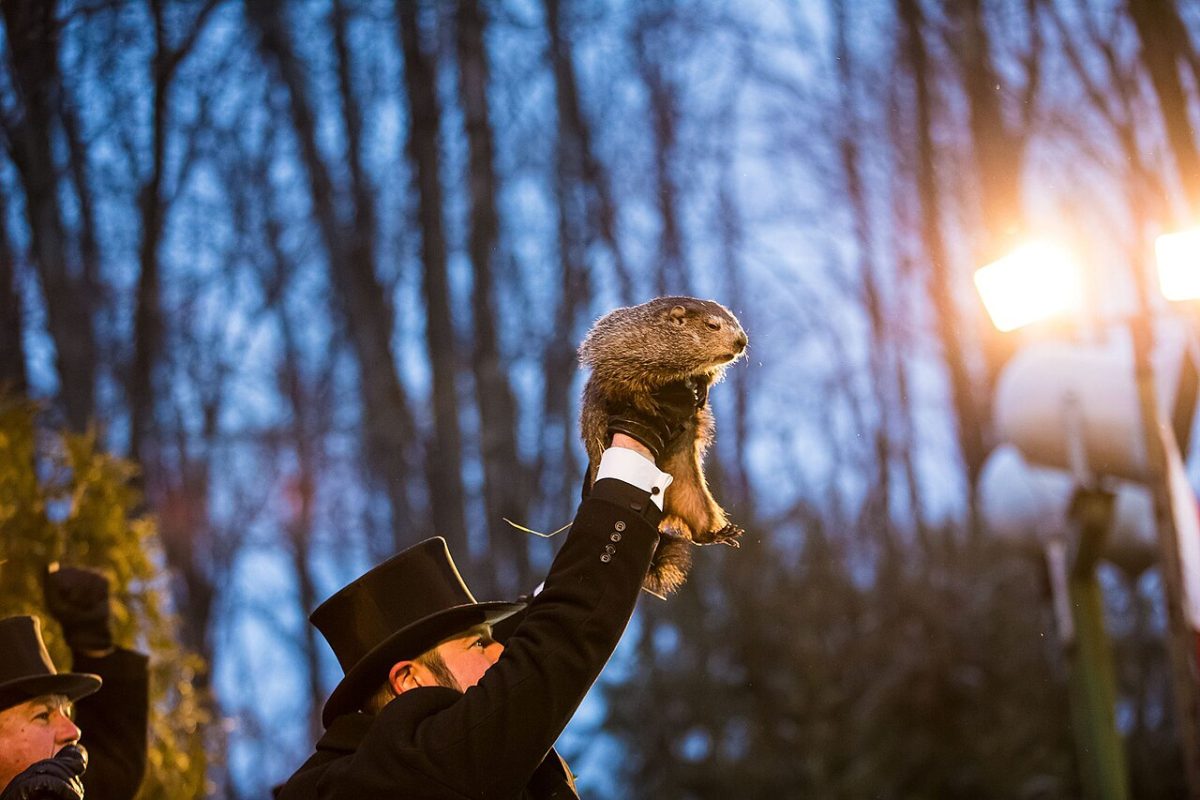
Each year on Feb. 2, crowds gather in Punxsutawney, Pa., as a groundhog named Punxsutawney Phil emerges from his burrow to “predict” the coming weather.
If Phil runs from his shadow, tradition says Americans will face six more weeks of winter. If he doesn’t, spring is coming early. But how well does Phil’s prediction stack up, especially in Bowling Green?
This year, on Groundhog Day, Phil ran from his shadow, signaling six more weeks of winter. But weather forecasters say his track record overall is far from perfect.
According to long-term data kept by weather analysts and historians, Phil has been correct only about 35% to 40% of the time since the tradition began in 1887, a rate that’s worse than flipping a coin.
Local weather patterns here in Bowling Green have shown the same unpredictability. The region’s average February temperatures hover in the mid-30 degrees, with March averages climbing into 40 degrees, but with wide swings from year to year.
Based on that winter-to-spring transition, it’s often hard to say with confidence whether “six more weeks of winter” will feel like winter or just cooler early spring conditions.
When we looked at Phil’s predictions over the last decade nationally, the outcomes show the struggle even more clearly. Between 2013 and 2023, Phil was only correct about four times, according to weather accuracy assessments based on February and March temperatures, an overall success rate near 30 % for that period.
“Honestly, I don’t trust him,” said sophomore Emily Harris. “It’s fun, but I check the weather app.”
Freshman Carlos Mendez echoed that sentiment.
“It’s a cute tradition, but it’s not scientific, so I don’t think it predicts real weather for us,” Mendez said.
Not all students dismissed the idea entirely; some see Groundhog Day more as a cultural tradition than a meteorological tool.
“I mean, if it’s right sometimes, that’s cool,” said junior Mia Thompson, “but I wouldn’t plan my spring break around it.”
Experts say Phil’s predictions are rooted in folklore brought to America by European settlers and celebrated for entertainment as much as weather forecasting. Modern meteorologists rely on climate models and daily atmospheric data, tools far beyond the simple shadow check that defines Groundhog Day.
So does Punxsutawney Phil ever get it right for Bowling Green? Technically, yes, sometimes his forecast lines up with how the season unfolds.
But statistically, his success rate is low overall, and local weather trends here show that Phil’s prediction isn’t a reliable guide.
Whether or not spring arrives “early,” one thing seems certain: Groundhog Day is more about tradition than science.