
“Sustainability is about making things last for future generations,” said Zach Hayes, Bowling Green State University’s (BGSU) sustainability coordinator.
BGSU students can help those future generations this Earth Month by making small, sustainable changes like not leaving lights on in rooms they aren’t in, drinking from reusable cups, walking to school or work and avoiding long, hot showers.
With each of these choices, energy is being used, leading to the release of greenhouse gases, air pollution and the depletion of non-renewable resources. Additionally, water consumption can lead to droughts, affecting both the environment and humans, as they both rely on water.
Water
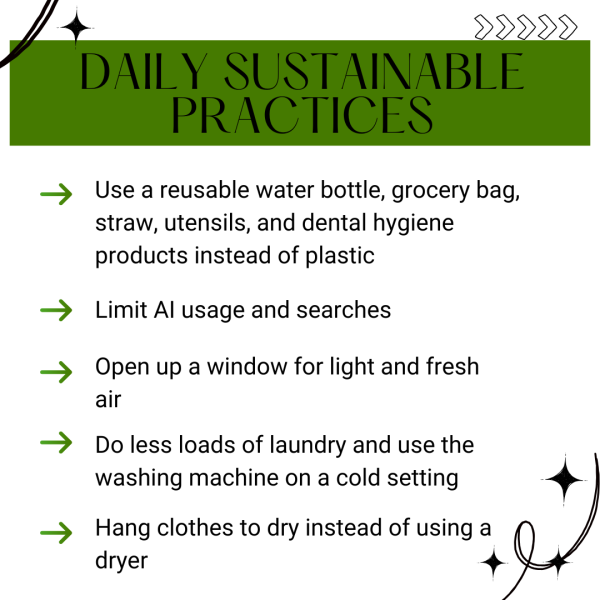
For example, the average household uses around 41 gallons of water per load of laundry in a washing machine, and a dryer accounts for about six percent of a household’s average energy use. To minimize this, it is recommended by experts to reduce the number of loads of laundry done, use the washing machine on cold or eco settings and hang clothes to dry instead of using a dryer.
“If we can think of things as a limited resource, then maybe people will be less likely to consume without needing to,” said Hayes.
Single-use plastic bottles are a large source of ocean pollution with 20 to 30 billion pounds of plastic entering oceans every year. According to a study in 2023, only one-third of all plastic bottles in the United States (U.S.) were recycled.
Plastic bottled water contains microplastics, which can be harmful to human health and the environment, and a study found that a typical liter of bottled water contains around 240,000 plastic fragments. Additionally, single-use bottled water systems have a larger overall carbon footprint than that of local tap water due to higher energy consumption.
Instead of using plastic water bottles, people can drink tap water and utilize reusable water bottles or cups for on-the-go activities.
Plastic also takes between 100 to 1,000 years to fully decompose, which makes it harmful to marine life as they can get tangled in the pollution, suffocate on it or ingest it.
Daily Tools
Mason Schragal, the treasurer of BGSU’s Environmental Action Group, suggested using reusable grocery bags, straws, silverware and food containers instead of each item’s plastic counterpart.
Additionally, dental hygiene products are usually single-use plastics: toothbrushes, toothpaste tubes, floss and dental picks all typically come from non-reusable plastics that end up in a landfill. However, according to G-Bio Energy, there are alternatives like bamboo toothbrushes, silk or corn floss and stainless-steel dental items.
Food
Food waste is another thing people produce every day without realizing how it negatively impacts the environment. Over one-third of food produced in the U.S. is never eaten, and food waste is the most common landfill material in the country.
The amount of water and energy used per year to accommodate U.S. food waste is enough to supply more than 50 million homes, according to the U.S. Environmental Protection Agency. Additionally, it takes the greenhouse gas emissions of more than 42 coal-fired power plants and agricultural land equal to the combined size of California and New York to deal with food waste in the U.S.
A study by the U.S. Department of Agriculture also shows that 13.7%, or 18.3 million, U.S. households in 2024 were food insecure and didn’t always have enough food for all members. Evidently, food waste not only impacts the environment, but humans and the local community too.
To reduce personal food waste, it is important to be mindful of portions and only buy what is needed and will be eaten. Hayes suggested BGSU students use or donate to the Falcon Food Pantry where food and hygiene products are available, and food within six months of its expiration date is accepted.
Transportation
Hayes also suggested BGSU students who live close to campus walk or bike to school instead of driving since 52% of BGSU’s transportation-related emissions come from motorized commutes.
Additionally, Schragal recommended opening windows for fresh air instead of running the heat or air conditioning, or simply using a window for sunlight instead of turning on a light that uses energy.
Artificial Intelligence
Although individual artificial intelligence (AI) searches do not cause huge impacts on the environment, they are all made possible by data centers. A medium-sized center can use up to 110 million gallons of water per year, and nationwide, about 56% of electricity used to power data centers comes from fossil fuels.
So, Hayes recommended people use written resources like research articles and regular search functions instead of generative AI.
Schragal noted that although a few of these daily activities are powered using “green” resources, the majority are not.
“We are using a ton of energy that we don’t really need to use, which is coming from coal burning, nuclear energy and other unsustainable resources,” said Schragal.
BGSU students looking to be more involved in sustainability events this Earth Month, visit the Office of Campus Sustainability’s website.