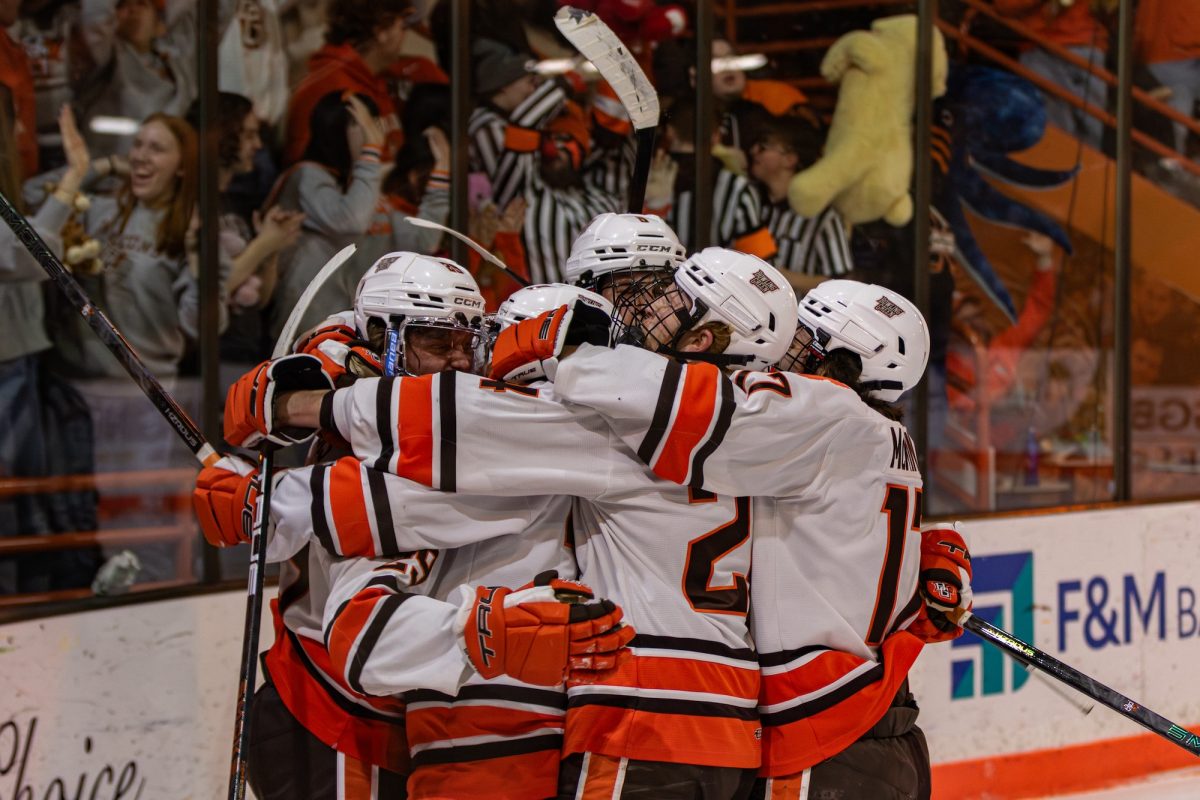
During BGSU hockey’s weekly press conference held on Feb. 10, head coach Dennis “Willy” Williams discussed his team’s defensive and goaltending play, puck management, getting pucks deep, and the upcoming challenge of facing one of college hockey’s toughest netminders.
Here are the Falcon Four takeaways from the press conference:
Defense and goaltending.
During BGSU’s weekend series against No. 15 St. Thomas (18-9-3, 15-5-2) last weekend, the Orange and Brown saw great defensive efforts throughout the weekend as the Falcons claimed four points towards the CCHA standings via a 3-2 overtime loss and a 3-1 victory.
The 3-1 victory, which came on Saturday night, is especially noteworthy as it is only the second time all season that a team has held the Tommies to only one goal.
“D were great, D were really good. Simple, with good intent,” said coach Williams. “They weren’t overextending themselves. They played within their means, their realm of what they needed to play.”
The Falcons’ defensive effort saw the team do multiple little things right, which allowed the team to succeed as a whole on the defensive side of the puck.
“I thought the D were doing a good job surfing, killing plays, guys like Ivan Korodiuk did a good job of being able to seal guys off and bring a physicality standpoint. I thought they did a good job of getting pucks up ice and off their stick and playing fast with pace.”
When the defense did have a breakdown and gave up a dangerous scoring opportunity, freshman goaltender Jacob Steinman was there to make the crucial saves.
“Any breakdown we had, Jacob was there.”
Puck Management
Puck management and avoiding turnovers are integral to a team’s success.
While a player never intends to turn over the puck to the opposing team, coach Williams explains that turnovers are inevitable, and what is more important is what a player does following a turnover.
“There’s gonna be turnovers, we all know that, at different times, so I always tell our guys, ‘you’re gonna turn the puck over, and that’s fine.’ But what do you do after you turn the puck over?” said Willi. “Are you a palms-up guy, do a big loop and skate, or do you stop, get back, three hard strides, look to get under the stick, look to close off that guy’s time and space, allowing our D to have a good gap?”
Williams continued, “For me it’s all about, you do your best, players don’t try to turn the puck over, you try to teach them where to manage the puck . . . From there, how do you deposit the puck, so you have the best opportunity to get it back. We don’t chip pucks, you put them into areas where you know you’re gonna get it back.”
Getting pucks deep
Building off of the puck management point, getting pucks deep is an old hockey adage that has been used by coaches at every level of the sport for decades.
Williams is no different as he explains that, “When you play with a stretch guy, you gotta shoulder check, see if you have time and space. If you have time and space, collect that puck and go in. If not, you gotta put it behind their D and make sure we sustain a good forecheck. I feel like we forecheck strongly. I think we’re on guys pretty hard. We have good second quicks going in the offensive zone. . . If you can play behind their D, you’re gonna have a better chance of winning hockey games.”
Kotai
This weekend, the Falcons will travel to Sioux Falls, South Dakota, to take on the No. 18 Augustana Vikings (18-9-3, 12-7-2) at Augustana’s Midco Arena.
One major challenge the Orange and Brown will face while in South Dakota is trying to score on junior goaltender Josh Kotai, who currently boasts 816 saves, a 2.09 goals against average, and a .933 save percentage as one of the best goaltenders in all of college hockey.
While not fully revealing his gameplan, Willy explained what it will take to score on the goaltending phenom.
“If you look at within our whole league, there’s a lot of good goalies, so it’s the same, you gotta get traffic over these guys,” said Willy. “You’re probably not gonna beat ‘em with any type of shot that he can see from anywhere outside the top of the circles or dots, so it’s gonna be even more important to get into the inside. Lateral movement and traffic’s gonna be important.”