Oil and water never mix. It’s basic science learned in elementary school. Water molecules stick with other water molecules, and oil molecules stick with other oil molecules. Oil and water just don’t mix.
But for Bowling Green’s freestyle swimmer Samia Becdach, oil and water mix perfectly.
Earning Mid-American Conference (MAC) Swimmer of the Week honors twice this season, there’s no doubt that Becdach has been a key player in the team’s success. This is a big feat for any student-athlete while balancing school, sports and social life. But Becdach isn’t just any student-athlete.
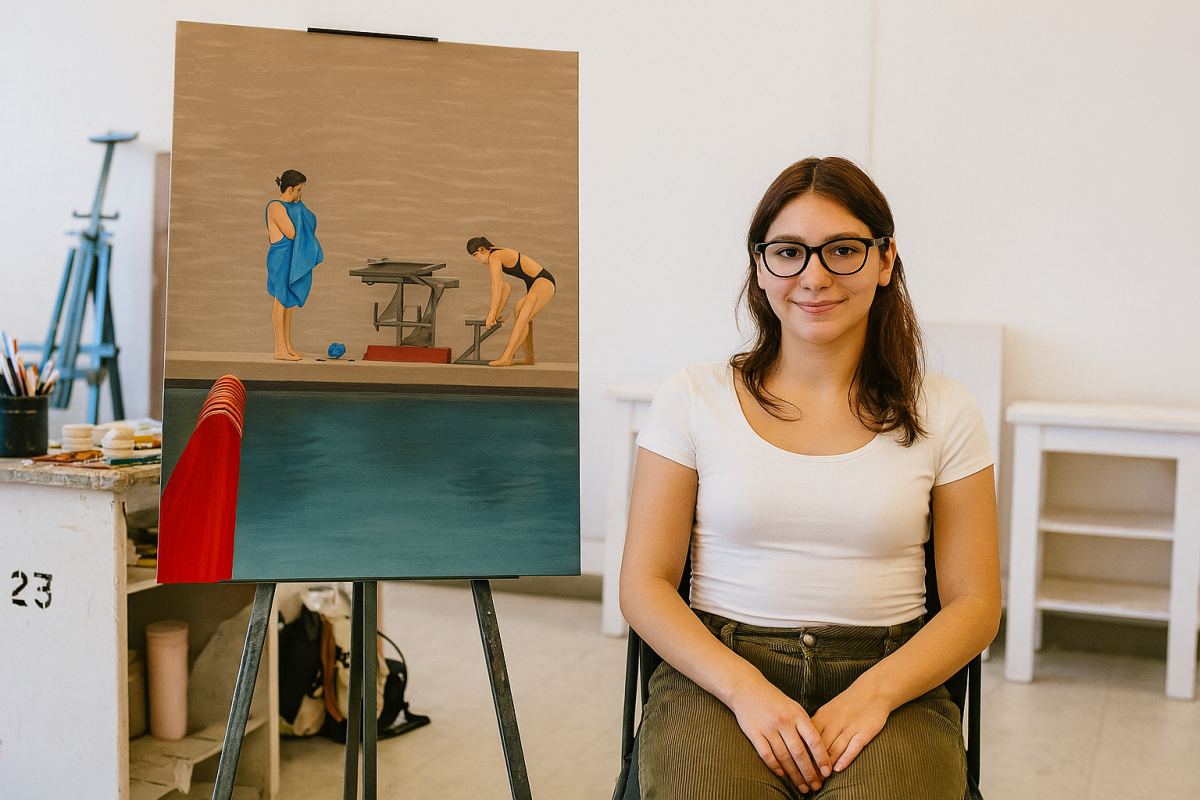
In a sea of student-athletes studying business, exercise science, or sports management, Becdach stands out studying studio art, in particular, oil painting. Instead of memorizing terms for an exam or writing research papers, Becdach takes her time with a canvas and a brush in the Fine Arts Center studio, taking in the world around her as her inspiration.
And for her, the world is usually a swimming pool.
“I just saw the light reflecting off the water and thought it was cool. A lot of my art is inspired by the environment I am in,” said Becdach. “This is like an everyday scene, us every day after practice, sometimes two times a day. Picking up our stuff, getting dry and ready to leave.”
“I was introduced to oil paint last semester, and I really like it. I like how smooth it is, and I can play with it. It’s really fun.”
Oil paint, while it has beautiful results, can take days to dry, making it difficult to transport from one place to another. This means, unlike other student-athletes on the road, she can’t take her projects with her to chip away at any work.
“It’s honestly really, really hard… studio classes take a lot of time, besides the class time, I have to spend five hours on my painting a week just to get it done,” said Becdach. “So what I do is normally work on it on the weekends, normally I just can’t have that many studio classes. For example, I wanted to take a glass blowing class as well, but I couldn’t because of my swimming schedule.”
“At the same time, the person is excelling and striving at something, they also have to make up for time that’s lost for their schoolwork,” said Professor Mille Guldbeck, an art professor at Bowling Green who’s been helping Becdach with her piece. “I think that’s really amazing to me. I think it’s something really admirable.”
But what’s the correlation between painting and swimming? Aren’t the arts and sports each other’s foils? The reality is that the relationship between art and artist and sport and athlete is more similar than most think.
“Art making generally is very competitive, and I always look at sports as being something that involves a certain level of competition, it involves trying to achieve excellence, it involves strenuous training,” said Guldbeck. “Those things are part of what makes an artist successful.”
But there’s more that makes Becdach’s school life a little more complicated. Not only is she a student-athlete navigating an art student’s schedule, but she’s also an international student hailing from Atacames, Ecuador.
Balancing school life, athletic life, and social life is “difficult because, especially when we’re young, there are so many other distractions,” said professor Guldbeck. “Being human beings and being young, our bodies and minds are wired to be out and experiencing it ourselves. We’re still in this growing period and there’s so much going on, and Samia’s also dealing with language issues.”
While Guldbeck may not be a competitive swimmer, she has experience with Becdach’s international experience.
“I’ve been there myself, I’ve lived in several different countries, so there are definitely hurdles you have to overcome,” Guldbeck said. “Often time we don’t talk about that so much. So I think there are those hurdles you have to overcome as an international student.”
She added she recognizes Becdach juggles athletics, art and finding personal connections.
“It’s about giving up things as well for that greater purpose one found,” Guldbeck said. “I’m sure there’s some camaraderie with the teams, I’m guessing, so maybe that’s where they get that connection to their fellow young people.”